
More than training: building a connected approach to workforce development
You can download this case study as a pdf document.
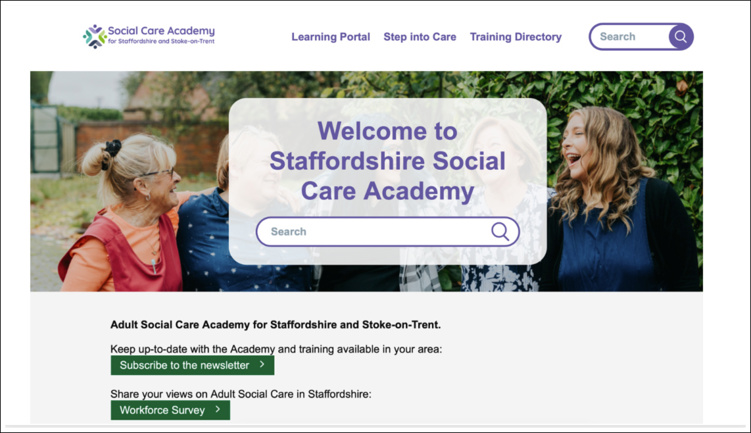
Across Staffordshire and Stoke-on-Trent, a wide range of organisations were already supporting adult social care workforce development, including the councils, care providers, health partners, colleges, universities and employment and skills organisations.
However, this activity was not always connected or easy to navigate. There was an opportunity to bring together existing resources, expertise and partnerships to create a more coordinated and accessible workforce offer, making it easier for care providers and individuals to find the training, development and career opportunities they needed.
The ambition was to build a more resilient workforce system, supporting recruitment and retention while creating clearer routes into care and opportunities for people already working in the sector to develop.
This wider approach was particularly relevant given the nature of workforce movement across Staffordshire and Stoke-on-Trent. While turnover rates are broadly comparable with other local authority areas in the West Midlands, staff often move between care providers rather than leaving adult social care altogether. This reinforces the importance of supporting career development and progression across the sector, alongside efforts to improve retention within individual organisations.
With this wider ambition in mind, the Social Care Academy was initially developed without additional funding or dedicated full-time resource, drawing instead on shared goals, strong partnerships and existing expertise. As the Academy moved into implementation and delivery, its resourcing grew to include one full-time role and the procurement of a Learning Management System.
Building the system
 The Academy was developed from Staffordshire’s wider social care workforce strategy. Rather than immediately creating new provision, partners first looked across the system at what already existed, where the gaps were and what could be better connected.
The development process mapped available training and potential funding, gathered intelligence about providers’ training needs, explored links with existing academies and considered routes into the workforce. Partners then worked through the practical infrastructure required – including governance, administration, branding, delivery arrangements, learning software, and stakeholder engagement.
A partnership was built around the work, bringing together local government, health, education and skills organisations, care providers and employers.
This meant the Academy could become the connecting infrastructure around existing workforce activity, rather than simply another programme operating alongside it.
The delivery model also includes e-learning courses developed in-house with subject matter experts. Some resources are co-produced with care providers. This reduces the need to buy the same training content year after year and helps tailor learning to local needs.
Alongside the online offer, a commissioned training programme funded through Better Care Fund resources responds to themes identified through quality assurance work. Its emphasis is on development beyond mandatory training, with learning increasingly aligned to the Care Workforce Pathway and consideration being given to formal qualifications.
Making progress without waiting for perfect conditions
 One of the strongest features of the approach was its pragmatism. Early development drew heavily on existing relationships, expertise and resources while partners developed the case for a more formal Academy.
The focus was on understanding the system, avoiding duplication and making better use of what was already available. Dedicated funding and capacity followed as the model developed.
This offers an important lesson for other local authorities: work can begin by connecting existing resources and partnerships; councils do not need to wait until every element of funding, infrastructure and delivery is in place.
What changed?
The Academy has created a more visible and coordinated workforce offer across Staffordshire and Stoke-on-Trent, bringing together learning, development, career and workforce support in one place.
More than 2,000 adult social care employees registered to access training through the Academy's learning platform in its first 12 months, providing an encouraging indication of reach.
This approach can be particularly valuable for smaller care providers. Smaller organisations may not have dedicated learning and development teams or the capacity to identify, commission and coordinate training across multiple sources. By bringing free or low-cost learning and career development opportunities together through a single portal, the Academy makes it easier for providers to find and access relevant, high-quality support. This helps build the skills and confidence of the workforce, supports better care and opens up routes into care for local people. Ultimately, this has a positive impact on people and communities across Staffordshire and Stoke-on-Trent.
The offer spans core care skills and leadership as well as areas such as dementia, medication management, autism, end-of-life care and digital skills. It is available across the sector, including care homes, home care, supported living and day services, as well as personal assistants and people considering a career in care.
The Social Care Academy has continued to see positive engagement, supporting more than 2,100 active users across Staffordshire and Stoke-on-Trent between February 2026-November 2026. During this time, learners completed over 2,000 eLearning courses and participated in more than 2,500 instances of live learning. Approximately 50% of adult social care locations across Staffordshire and Stoke-on-Trent had at least one member of staff registered with the Academy.
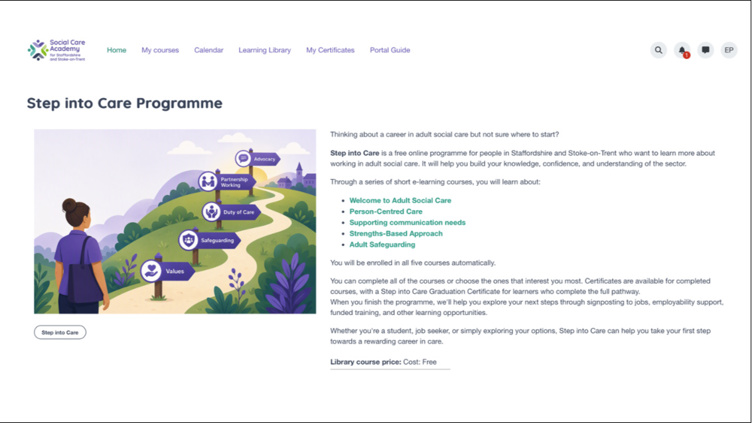
The Academy has also expanded its focus towards workforce attraction through the launch of Step into Care, a free online programme designed to help people across Staffordshire and Stoke-on-Trent explore careers in adult social care.
Delivered through the Academy's learning platform, the programme provides an accessible introduction to the sector through five short e-learning courses covering adult social care, person-centred care, communication, strengths-based approaches and safeguarding. Learners can complete individual courses or the full pathway, with certificates recognising their achievements. Alongside engagement with colleges and careers services, this developing offer aims to create clearer routes into the workforce, connecting early career exploration with learning and employment opportunities.
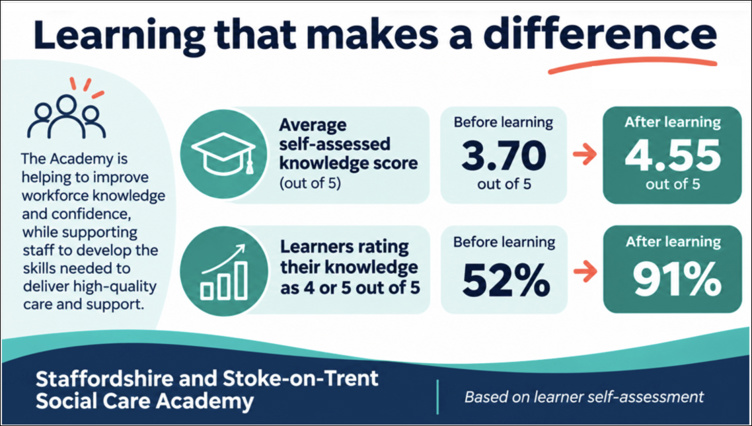
The Social Care Academy has demonstrated positive learning outcomes across its training offer. Based on learner self-assessment data, the average knowledge score increased from 3.70 to 4.55 out of 5 following completion of Academy learning. The proportion of learners rating their knowledge as 4 or above out of 5 also increased significantly, rising from 52% before learning to 91% afterwards. These results suggest that the Academy is helping to improve workforce knowledge and confidence, while supporting staff to develop the skills needed to deliver high-quality care and support.
Peter Wood, Senior Quality Intelligence and Market Development Officer at Staffordshire County Council said, “For me, the success of the Social Care Academy has been about making development more accessible. We have seen strong engagement, and it has been great to see people using the Academy to build their knowledge, confidence, and skills. It has also brought Councils, care providers, and partners together around a shared workforce offer, rather than everyone working separately. There is still more we want to do, but I think we have shown what can be achieved when we listen to the sector, identify the gaps and make learning easier for people to access.”
Members of the academy continue to provide positive feedback on the learning content:
“This was an excellent course and very constructive. I am able to take the knowledge I have received, and implement it more frequently in my role.”
“Good insight to the care planning structure in a short section”
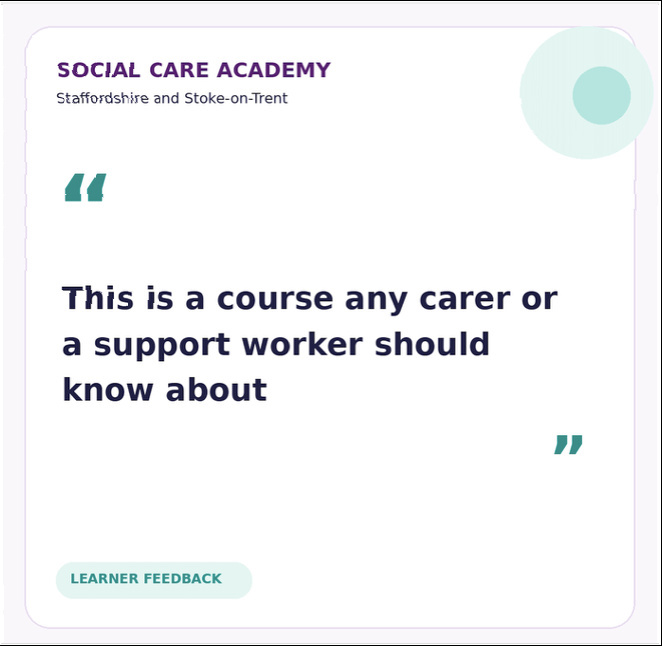
“This is a course any carer or a support worker should know about”
“This training provides an excellent foundation in both the practical and emotional aspects of end-of-life care… ensuring staff are equipped to offer dignified, person-centred support.”
“A very easy to follow course… offering a good range of what is required to use an effective and professional handover.”
What can we learn?
The Staffordshire and Stoke-on-Trent experience demonstrates that a care academy can be more than a training offer. It can provide the shared infrastructure that connects employers, workforce, education, skills, economic growth and public-sector partners around a shared workforce challenge.
For providers, this can mean a simpler route into training, development and workforce support. For councils and system partners, it provides a way to coordinate existing resources, identify gaps and reduce duplication.
For other councils, the starting point may therefore not be "How do we fund an Academy?" but "What do we already have, where are the gaps, and how can we make it easier for providers and the workforce to access what they need?" This approach demonstrates how meaningful workforce improvements can begin through better coordination of existing resources, without necessarily requiring significant additional investment.
Much of the Academy’s value comes from the relationships built with local care providers, the co-production of learning opportunities and the way training is connected to wider workforce development and quality improvement activity. For councils looking to develop a similar approach, it is worth considering not only the technology and resources required, but also how the Academy can be embedded within existing local partnerships and support arrangements.