
Communities of Practice meeting on mental ill/health
By Sandra Simpson, Social Worker and WM ADASS Research Engagement Lead
The Communities of Practice session on 29 May was hosted by City of Wolverhampton Council and brought social care practitioners together for an important conversation about mental health, mental ill health and the need to challenge stigma.
I opened by highlighting that mental health affects everyone, with around one in four people in England experiencing a mental ill health each year.
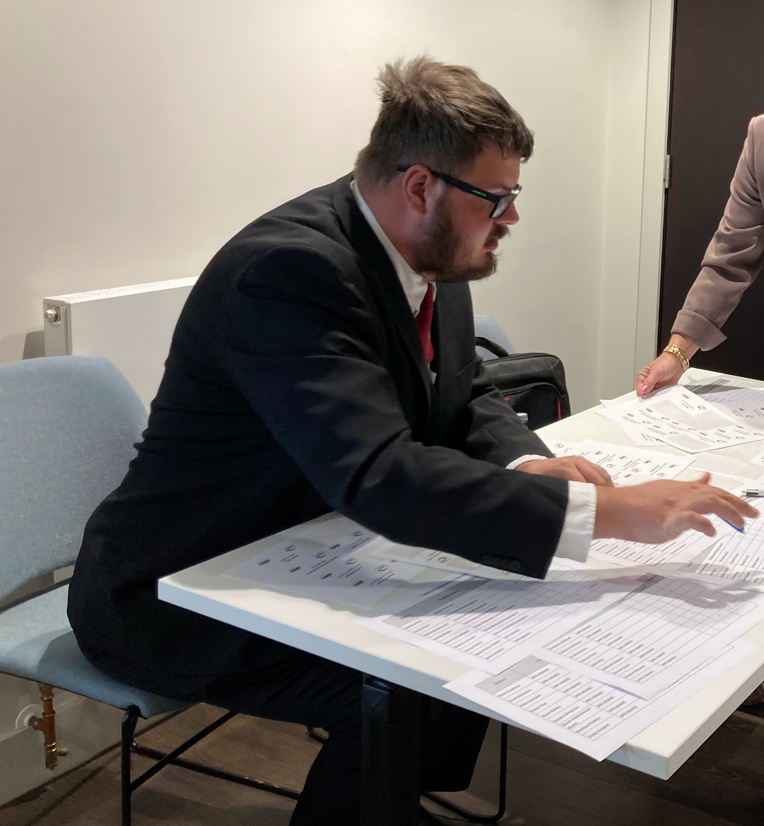
Kieran Jones delivered a powerful presentation about his journey of being diagnosed with anxiety and depression, and his experience of being in a mental health unit. (see Kieran's account of his contribution below)
Kieran spoke openly about how mental ill health manifested for him and what led him to feel alone at the time. Kieran also shared valuable “golden nuggets” on how best to support someone experiencing mental ill health, including what meaningful and compassionate support can feel like.
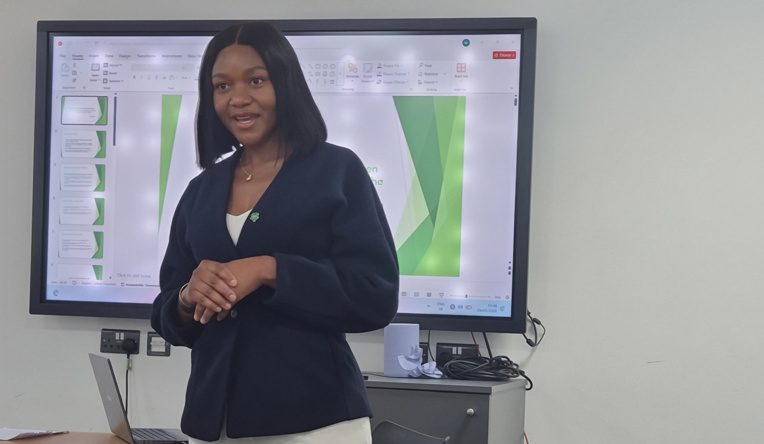
Naomi Elendu facilitated a thought-provoking session on the wellbeing of adult social care workers. She shared insightful facts about the cost of sickness absence across the workforce, emphasised the importance of self-care and offered practical wellbeing tips.
Her session prompted important discussion about recognising the signs of burnout and systemic barriers impacting the ability for social care workers to address their wellbeing. Naomi also highlighted the impact of racial discrimination within the social care workforce.
Sylwia Juranek closed the session with an impactful contribution on trauma in a range of contexts, including generational and cultural trauma, its impact on parenting and children, and trauma arising from sexual violence and abuse.
She also explored the physical effects of trauma and the importance of understanding people’s experiences through a trauma-informed lens. Sylwia highlighted the often-hidden population of Polish people who require mental health support but are underserved because they are categorised within the broad “white other” group. This issue stressed the importance of disaggregating data so that people’s distinct needs are properly recognised and met.
My Mental Health Journey
by Kieran Jones, WM ADASS Programme Support Officer
I was invited to present from a lived experience perspective, sharing my personal journey through mental illness and discussing what I believe needs to change in the way local authorities and services support people experiencing mental health challenges. It was an opportunity to speak openly, honestly and authentically about the realities of living with mental illness and the lessons that can be learned from those who have experienced it first-hand.
I reflected on receiving my diagnoses of anxiety and depression, and how gaining a better understanding of these conditions helped me make sense of what I was experiencing. I shared what mental health looked like for me on a daily basis, and the factors that left me feeling isolated and alone before I received a diagnosis and the support I needed.
I also spoke candidly about my time in a mental health unit and the impact that poor mental health had on my education, career aspirations and confidence. Like many people, I experienced moments where it felt impossible to see a way forward.
However, I also discussed the turning point in my recovery – the moment when things began to change and I started receiving the right support, understanding and encouragement to move forward.
What works well when supporting mental health?
One of the key messages from my presentation was that effective mental health support is not complicated, but it does require empathy, understanding and a person-centred approach. Some of the things that I believe work well include:
- Listening without judgement.
- Matching individuals with professionals they feel comfortable with.
- Recognising that everyone experiences mental health differently.
- Finding the support that works best for the individual.
- Understanding that there is no "one-size-fits-all" approach.
Good support starts with listening and recognising that the individual is the expert in their own experiences.
What doesn't work so well?
I also highlighted some common mistakes that can make support less effective or even harmful. These include:
- Dismissing someone's feelings or experiences.
- Assuming professionals always know best.
- Failing to involve individuals in decisions about their care.
- Not listening to what people are actually saying.
- Schools and organisations failing to make reasonable adjustments.
- Telling people to "grow up" or putting words into their mouths.
When people reach out for help, they need to feel heard, respected and believed. Without this foundation, meaningful support becomes much harder to achieve.
Improving mental health services in the West Midlands
During the session, I explored several ways in which mental health services across the West Midlands could be strengthened and improved. Some of the suggestions included:
- Greater investment in digital tools and technologies, including Artificial Intelligence (AI).
- Embedding lived experience into staff training and workforce development.
- Increasing awareness and understanding of mental health.
- Better promotion and marketing of available services.
- Establishing mental health working groups and steering groups.
- Expanding opportunities for co-production and involving people with lived experience in service design.
The people who use services have valuable insights that can help shape better support. Their voices should be at the centre of improvement efforts, not consulted as an afterthought.
What does good support feel like?
One of the most powerful discussions during the session centred on how support actually feels to the person receiving it. Good support can feel like:
- A warm blanket on a cold day.
- Having a safety net when things become difficult.
- Receiving an injection of confidence.
- Someone genuinely cares.
- Most importantly, you are not alone.
When support is done well, it can provide hope, reassurance and the confidence needed to take positive steps forward.
What does bad support feel like?
- Unfortunately, poor support can have the opposite effect. Bad support can feel like:
- Nothing will ever change.
- There is no point attending appointments or sessions.
- Nobody is listening or cares.
- Getting better is a dream rather than a reality.
These feelings can increase isolation and make it harder for individuals to engage with services when they need them most.
Top tips for managing mental health
- I also shared some practical advice that has helped me throughout my own journey:
- Be open to the advice and support available to you.
- Don't push away the people who want to help.
- Try to focus on the positives, even during difficult times.
- Make use of helpful tools and technologies, including AI where appropriate.
- Surround yourself with supportive people.
- Try to get outside and walk regularly.
- Ask for help when you need it.
- Remember that you do not have to face challenges alone.
Most importantly, believe that things can and do get better.
Mental health support should be a necessity, not a luxury
One of the strongest messages from my presentation was that mental illness is not enjoyable, easy or something that people choose to experience. It can affect every aspect of someone's life, from their relationships and education to their employment and confidence.
Support for people with mental illness should not be something they have to fight for. It should not be a privilege or an optional extra. It should be recognised as a necessity and a statutory responsibility for organisations supporting some of the most vulnerable members of our communities.
Reflections
The session concluded with an engaging question-and-answer session with attendees. It was encouraging to see so many professionals wanting to understand how services can improve and how lived experience can play a greater role in shaping the future of mental health support.
Since the event, I have received some very positive feedback, which has been incredibly rewarding. If sharing my experiences helps even one person feel understood, or encourages one organisation to improve the way it supports people with mental illness, then it has been worthwhile.
Mental health affects us all in different ways, but one thing remains true: nobody should have to face it alone.
AI in Adult Social Care: Bridging Two Worlds
By Pete Jackson (WM ADASS) and Sandra Simpson, Social Worker and WM ADASS Research Engagement Lead
Artificial intelligence is no longer a future concept in adult social care. It is already present — shaping how people live their lives and how professionals carry out their work.
Across the West Midlands, we are beginning to understand AI through two connected but often separate perspectives: the experiences of people who draw on care and support, and the emerging use of AI within social work practice.
Bringing these two worlds together is now one of the most important challenges facing the sector.
Pete Jackson: Starting with Lived Experience
Through the WM ADASS AI Playbook, we have been working with people who draw on care and support to understand how AI is being used in everyday life.
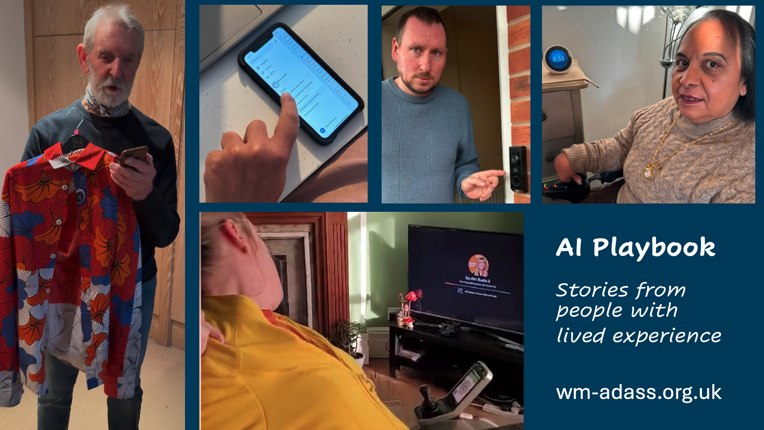
Cover of the WM ADASS AI Playbook
What stands out is how grounded these uses are.
People are not talking about AI in abstract or technical terms. They are using it to:
- understand letters
- draft messages
- organise appointments
- express themselves more clearly
- use publicly available apps to assist with everyday tasks
These are small, practical actions — but they have a significant impact.
As one contributor shared:
“It helps me do things for myself without having to ask my personal assistant.”
This is what independence looks like in practice. Not dramatic transformation, but the ability to live what Social Care Future describes as a “gloriously ordinary life.”
The Playbook captures these stories to show how AI, when used in the right way, can support autonomy, confidence, and participation.
But these stories are not uncritical. People also raise concerns about trust, accuracy, and privacy. They are thoughtful users of technology, navigating both its benefits and its risks.
Sandra Simpson: AI in Social Work Practice
At the same time, AI is being introduced into social work practice at speed.
As explored through recent WM ADASS Communities of Practice work, practitioners are beginning to use AI tools for transcription, summarising case notes, and managing administrative tasks. The aspiration to reduce workload and increase efficiency has been widely cited as a catalyst for AI implementation within adult social care.
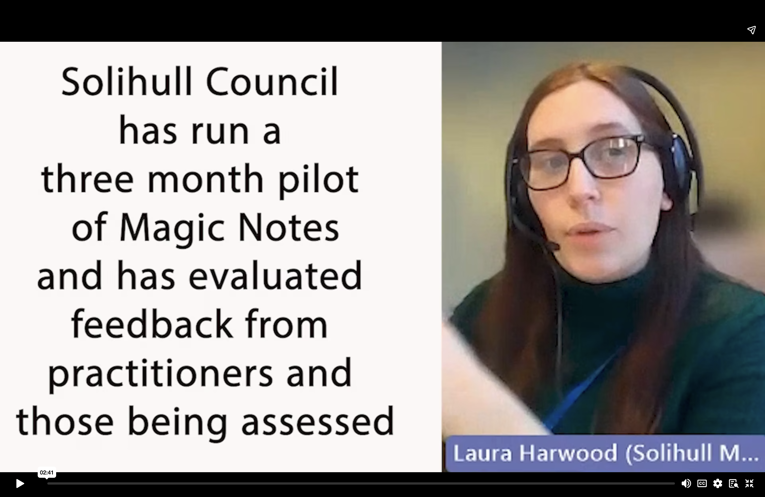
Still from the video of Solihull's presentation at the WM ADASS AI webinar February 2025
For some practitioners, including those with disabilities, these tools provide an opportunity to help them manage cognitive load caused by administrative pressure.
However, this shift also raises important questions.
AI systems are not neutral. They can mirror and perpetuate existing forms of oppression. Concerns raised through the Communities of Practice include:
- Algorithmic bias within AI systems
- Hallucinations, inaccuracies in transcription and summarisation
- Questions of accountability, transparency and professional responsibility
- The risk of over-reliance on automated outputs and the implications for professional confidence.
Research by the Ada Lovelace Institute documented that one social worker utilised a transcription tool to create a summary and it erroneously “indicated that there was suicidal ideation” although ‘at no point did the client actually, you know, talk about suicidal ideation or planning, or anything’. The social worker added: “If I hadn’t checked that and it had gone into the case note… that could have had implications further on down the road.” This incident highlights the need for vigilance and oversight when using AI tools.
This brings into focus a critical issue: how do we ensure that AI supports professional judgement rather than undermines it?
Bringing the Perspectives Together
These two perspectives, lived experience and professional practice, are interconnected.
At one end, people are using AI to live more independently.
At the other end, professionals are using AI to interpret, record, analyse assessments and produce summaries.
If these developments happen in isolation, there is a risk that AI becomes something that is done to people rather than shaped with them.
Key questions emerge:
- Do people who access adult social care understand how AI is being used in their interactions with adult social care workers?
- Do practitioners understand how people are already using AI in their everyday lives?
- How do we ensure transparency and shared understanding?
A Shared Opportunity
The WM ADASS AI Playbook offers one way of addressing this gap by grounding AI in real stories and lived experience.
Alongside this, emerging research into AI and social work practice is helping us to critically examine how these tools are being introduced and used.
Together, they point towards a shared opportunity to:
- embed ethical, human rights-based approaches to AI
- support practitioners to use AI critically and confidently
- ensure lived experience shapes design and implementation
- build trust through transparency and dialogue
Looking Ahead
AI has the potential to support independence, reduce burden, and open up new possibilities within adult social care.
But it also raises fundamental questions about power, accountability, and what it means to care.
If we are to realise the benefits of AI, we need to keep these conversations grounded in real lives and ensure that innovation is shaped through collaboration between people who draw on care and those who support them.
This blog is the beginning of that conversation. We will continue to develop this work, including further research and potential publication with organisations such as BASW, to explore how AI can be used responsibly, ethically, and in ways that genuinely support people to live the lives they want to lead.
Further Reading
Community of Practice for Commissioners & Researchers event
By Kathryn Hudson PhD WM ADASS Research Programme Lead, 17 March 2026
The March 12 event, held at the University of Birmingham, was the second meeting of the Community of Practice for Commissioners and Researchers
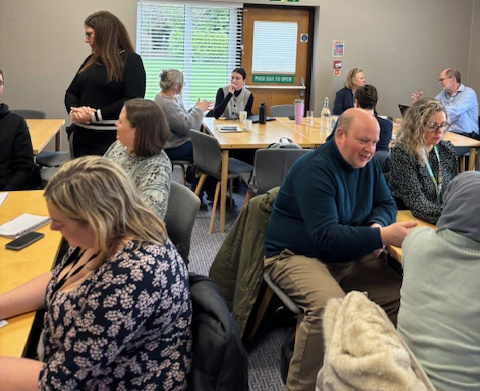
The well-attended meeting was chaired by Graham Betts CBE and Patrick Hall, who reiterated the CoP’s purpose: strengthening the relationship between commissioning and research to improve evidence, practice, and outcomes across adult social care.
The event brought together commissioners, researchers and partners from across the West Midlands and national universities looking to strengthen evidence‑informed commissioning and support the development of a research‑active social care system.
The first presentation was from Professor Matt Bennett, University of Birmingham who outlined work commissioned by DHSC to design and pilot a national, representative survey of unpaid carers, covering diverse experiences, needs and outcomes. The project includes co‑design panels, piloting sampling models, and future‑proofing through administrative data linkage and longitudinal design. West Midlands is a key pilot area.
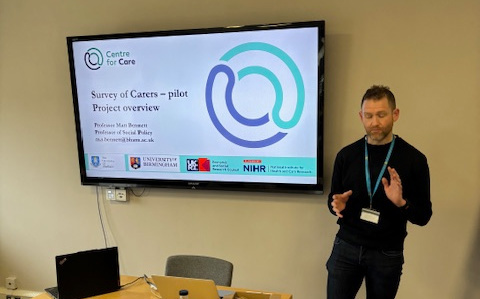
There are opportunities for commissioners to get involved by joining co‑design panels (five 2‑hour sessions); participating in a local authority panel for colleagues working on carer wellbeing, strategy and delivery; and by helping shape the question set, particularly for carers supporting people with dementia or learning disabilities.
Next up, Keshena Bowie described Birmingham Voluntary Service Council’s programme that is training community researchers from diverse backgrounds in research methods, ethics, interviews, and thematic analysis. Community researchers are paid in accordance with NIHR guidance and projects typically run 16–18 weeks. The model is used across public health and NHS‑funded work.
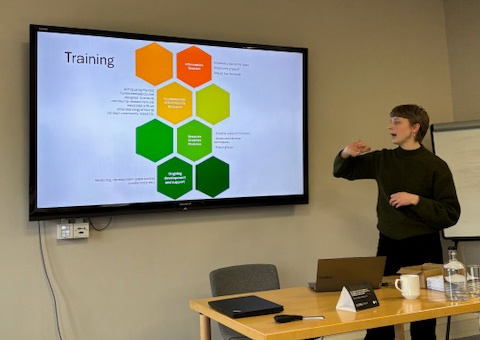
Opportunities to get involved include commissioning community‑based qualitative research, and using community researchers to access communities and capture lived experience insights.
Patrick Hall then shared findings on the identity and culture of commissioning, highlighting discomfort among some practitioners with the “commissioner” label and the need for clearer professional identity, career pathways and competencies. He provided historical context from post‑war social care to modern commissioning practice.
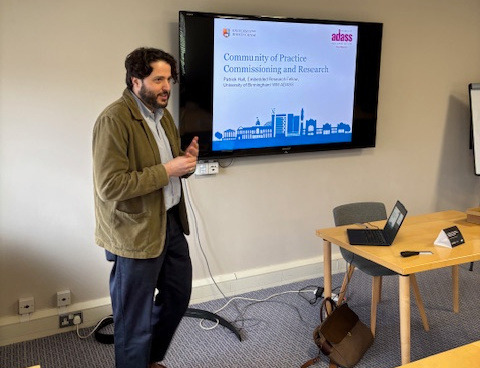
There are opportunities for people to get engaged in ongoing work exploring commissioning identity, skills and development pathways.
In the final presentation Dr Steve Williams of University of Birmingham described an NIHR‑funded project exploring hidden costs of hospital discharge for older adults, families, NHS and social care. The study includes literature review, 15 stakeholder interviews, and follow‑up of 40 adults discharged from Birmingham and Coventry & Warwickshire hospitals, with costed discharge pathways to be developed.
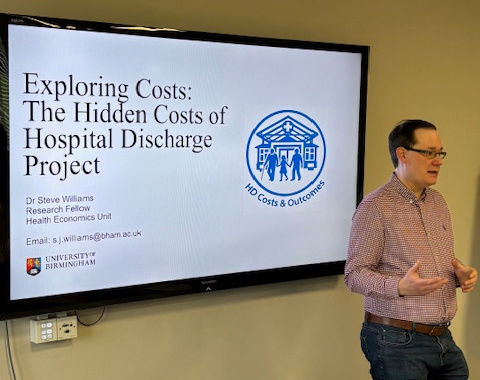
Again, there are opportunities for commissioners to get involved by sharing local strategic/operational documents, contributing commissioning insight and participating in interviews.
Following the presentations there was a discussion around priority areas for future sessions of the Community of Practice, which identifed:
- Neighbourhood health planning and implications for social care.
- Quantifying the benefits of prevention.
- Comparing costs and outcomes of in‑house vs externally commissioned provision.
- Implications of the Procurement Act 2023.
- CQC themes, benchmarking, and carers’ assessments.
- Accessing NIHR and other research funding for local authority‑led research.
Colleagues expressed warm thanks to Patrick Hall as he moves into his new commissioner role in Walsall, recognising his major contribution to building and sustaining the Community of Practice and his intention to remain connected.
If you would like to get involved in the Community of Practice please contact Kathryn.Hudson@wm-adass.org.uk.
Reflections from Oslo, Norway and Black History Month
By Sandra Simpson, Research Engagement Lead, 13 February 2026
I've had this blog in my drafts since October 2025, unsure of how to conclude it.
However, life has found a natural and positive ending. Let's start from the beginning...
Thanks to the British Association of Social Work, I was successful in gaining funding to attend the International Federation of Social Work European conference in Oslo, Norway. It was a phenomenal and joyful experience.
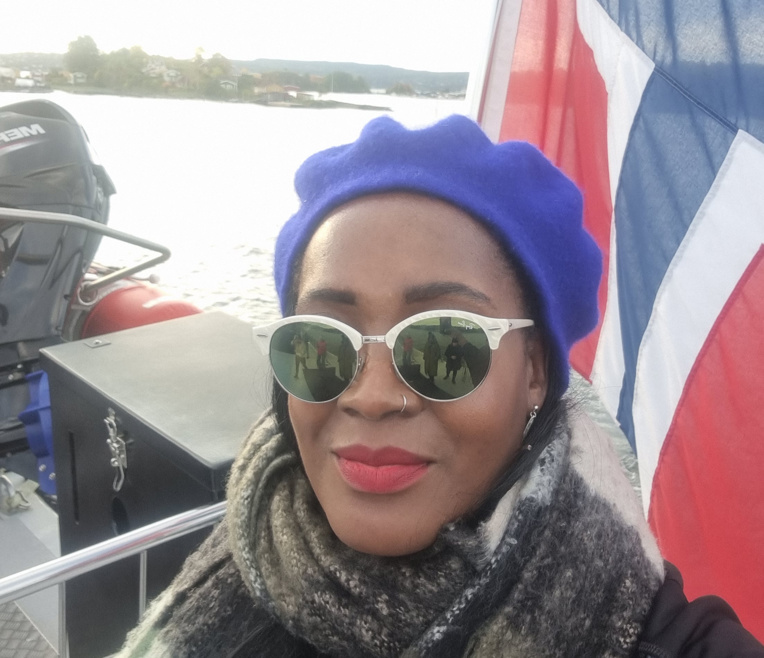
It was fitting that I had such an experience during Black History Month, a reminder of the importance of Black joy and rest. For once, my sole mission was to learn, develop and connect.
The reception and welcome on the first day were exceptional. The conference commenced on a high note, setting a positive tone for the entire event. A golden thread of sustainability ran throughout, even extending to the musician, who used sustainable instruments, including a goat horn. The culture of singing and dancing was delightful.
A particularly memorable quote from the session was, 'We do not inherit the earth from our ancestors; we borrow it from our children'.
This served as a stark reminder of our accountability as adults and the need to make changes for now and future generations.
The evening reception was amazing. The significance of holding the event in the city hall, where the Nobel Peace Prize is awarded, added to the sense of honour.
Throughout the conference, I felt appreciated not only because of the selection of fantastic speakers but also because of the food provision. I definitely put on a few pounds as I can’t say no to cake!
At the opening address of the conference, time was dedicated to remembering Tamima Nibras Juhar, a 34-year-old social worker, who was murdered by an 18- year-old she was supporting. The murder was racially motivated. I found the news shocking and saddening. All delegates went silent at the unexpected nature of the announcement.
Alongside learning about the passing of Tamima, the speaker made reference to racism within the UK, underscoring the prevalence of the issue back home. Though hearing the news of Tamima was awful, I was proud to be part of the collective acknowledging the significance of her life.
“Beloved community is formed not by the eradication of difference but by its affirmation, by each of us claiming the identities and cultural legacies that shape who we are and how we live in the world” (bell hooks 1995).
Before the conference, I had been reflecting on my own safety as a Black woman in a front-facing role. While I’ve not heard of incidences of racially motivated murder within the context of social care, increasingly, I am hearing experiences of Black social workers and paid carers being racially abused and being made to feel unwelcome.
As we continue to see a rise in the far-right and anti-immigration rhetoric, consideration for the safety of targeted groups needs to be at the forefront of our minds. Empathy and incident report form filling are not enough. Anything less than proactive steps, well, Archbishop Desmond Tutu said it best…"If you are neutral in situations of injustice, you have chosen the side of the oppressor”
The conference effectively highlighted the interconnectedness of all forms of oppression and the need for green social work. If you left the conference not seeing that connection and the impact of colonisation, you were disconnected.
Hurricane Melissa, alongside many natural disasters, is a case in point. Hearing the heartbreak in my mother’s voice about her country was sobering. Thankfully, my family were “ok”, but that was not the case for many. To paraphrase the keynote speaker at the conference, Dag Olav Hessen, writer and biologist: ‘those least contributing towards climate change are most impacted.’ We all need to wake
up.
“We are caught in an inescapable network of mutuality, tied in a single garment of destiny. Whatever affects one directly affects all indirectly.”
Dr Martin Luther King, Jr., Letter from a Birmingham Jail, April 16, 1963.
During the conference, I spoke with social workers who attended for the first time. It struck me that they did not feel entitled to occupy the conference space. This was an acute reminder of the disconnect between academia, research and practice.
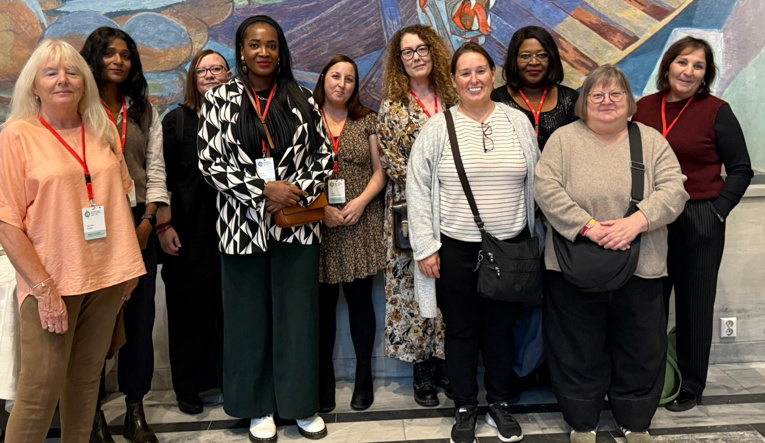
I hope that, after attending the conference, they feel a sense of ownership over this space and that they recognise our right to access new knowledge, to contribute to it, and to challenge it. Research is a fundamental element of social work practice. With that said, after the conference, I put forward my own abstract to the Joint World Conference on Social Work, Education and Social Development in Kenya, and it was accepted.
It will be my first international conference as a speaker, and hopefully not the last. I am sure plenty of lessons will be learned and shared in future blogs.
I look forward to occupying MY space at the conference and sharing my contributions with attendees.
Upcoming events:
24/02/26 10:30- 14:00 West Midlands ADASS Research Led Communities of Practice. The theme of this event is AI in adult social care. Click on this link to get further information and register.
Reflections from September: A New Beginning
By Sandra Simpson, Research Engagement Lead, 20 October 2025
September was a month full of new beginnings. I had the privilege of attending my first Communities of Practice (CoP) for adult social care commissioners in the West Midlands, hosted by my colleague, Patrick Hall, our embedded research fellow with West Midlands ADASS from the University of Birmingham. This experience provided me with valuable insight into the work of commissioners and how they plan to incorporate research evidence into their roles. Although I was supposed to be there to support with facilitation, I found myself so engrossed in the conversations that I ended up joining in. Sorry Patrick!
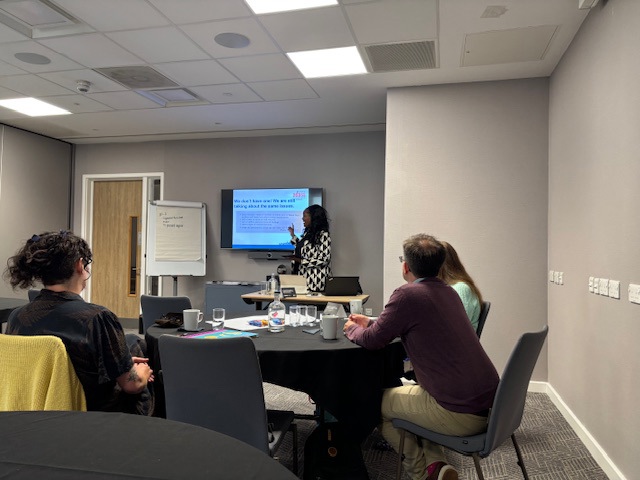
The following week, it was my turn to facilitate a CoP for adult social care workers, ‘Connecting with Research: Establishing a Community of Practice for Adult Social Care Workers in the West Midlands’. Unlike the previous week, I was not feeling as relaxed and chatty as I was in my assigned "facilitator role." They say a watched phone never rings, but in my case, a watched door never opens. I have never focused on a door so much. I was apprehensive about the turnout; however, 14 attended. While this may not sound like a lot for a regional event, the reality is that it is really challenging to get practitioners away from work due to workload and workforce challenges. I could not have wished for a better turnout. There was so much passion in the room for research and pushing forward. A lot of brain power was involved. Luckily, a nice lunch followed to take the edge off. It was a lesson for me to be mindful of the cognitive load work like this involves. Thinking is tiring!
From my own perspective, it was the first time I organised a Community of Practice (CoP), and doing something new can always be a bit daunting. However, what is essential is to remember the ‘why’. The ‘why’ is that there is a deep need to embed a research culture within adult social care across the West Midlands and nationally. Underpinning the ‘why’ is the drive to improve the lives of people who access adult social care. The hope is that the CoP will contribute towards that cultural change. Like all big cultural changes, the important thing is to start and just keep going, growing and learning.
Reflecting on the first CoP session, there are definitely a few things I would do differently, and I can perhaps start implementing them in the future. Firstly, I would send out the slides and discussion points beforehand to give people an opportunity to think and write notes. Although there was a diverse range of members working in different roles, I would like to put more effort into including support workers and carers working in adult social care.
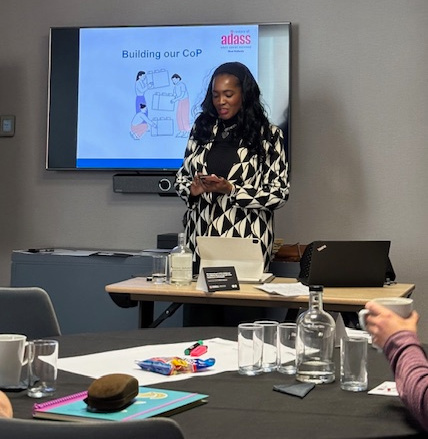
I also regret not inviting a guest speaker to provide a different perspective and inspiration. It would have given members a break from my voice. Additionally, making use of technology to break up the experience to make it more engaging would have been beneficial. More importantly, though, I should have brought more sweets! Every day is a school day.
Another first for me was being invited as a guest speaker to the West Midlands Social Work Teaching Partnership visioning event. I felt so welcomed by all the attendees. I presented my CAPE model, a potential framework for building a research culture. CAPE is an acronym for the following domains: Consume, Apply, Participate, and Encourage. I hope that by implementing these habits in everyday practice, we will develop a research culture. The model speaks to a wide range of practitioners; it may include a practitioner who just wants to read research (Consume) or a practitioner who would like to undertake research. The model has something to offer everyone; it is not about making every social care practitioner an academic. It is about meeting people where they are on their research journey and supporting. The level of engagement and feedback from the model blew me away. The Q&A session was dynamic, and I gained tremendous insight into the dedication and work involved in the West Midlands Social Work Teaching Partnership. One of my biggest takeaways was how much partners care about the future of the profession and beyond.
Additionally, I received positive feedback regarding my public speaking abilities from several partners. Obviously, I am now going to put myself forward for a TEDx talk! On a serious note, if you are interested in embedding a research culture and you want to learn from my triumphs and failures, please don’t hesitate to contact me.
September was full of transformative experiences. I am forever grateful for the opportunity to be a part of embedding a research culture in adult social care across the West Midlands.
Our second Community of Practice will be held online in November 2025. The date and time are to be confirmed, but if you are interested, please do contact me via email at sandra.simpson@wm-adass.org.uk