
Artificial intelligence is no longer a future concept in adult social care. It is already present — shaping how people live their lives and how professionals carry out their work.
Across the West Midlands, we are beginning to understand AI through two connected but often separate perspectives: the experiences of people who draw on care and support, and the emerging use of AI within social work practice.
Bringing these two worlds together is now one of the most important challenges facing the sector.
Pete Jackson: Starting with Lived Experience
Through the WM ADASS AI Playbook, we have been working with people who draw on care and support to understand how AI is being used in everyday life.
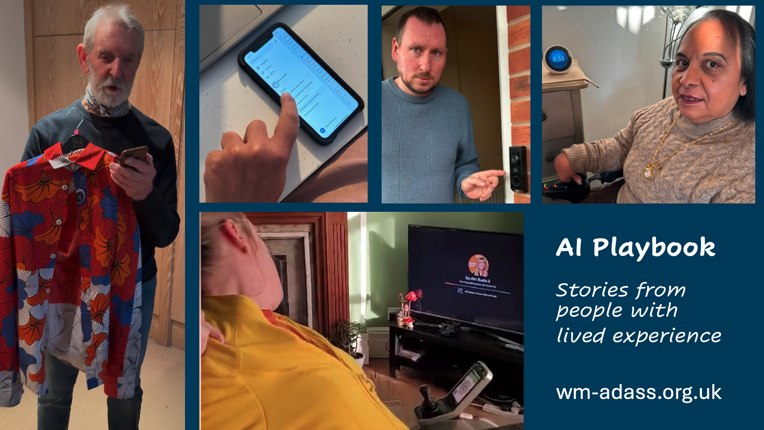
Cover of the WM ADASS AI Playbook
What stands out is how grounded these uses are.
People are not talking about AI in abstract or technical terms. They are using it to:
- understand letters
- draft messages
- organise appointments
- express themselves more clearly
- use publicly available apps to assist with everyday tasks
These are small, practical actions — but they have a significant impact.
As one contributor shared:
“It helps me do things for myself without having to ask my personal assistant.”
This is what independence looks like in practice. Not dramatic transformation, but the ability to live what Social Care Future describes as a “gloriously ordinary life.”
The Playbook captures these stories to show how AI, when used in the right way, can support autonomy, confidence, and participation.
But these stories are not uncritical. People also raise concerns about trust, accuracy, and privacy. They are thoughtful users of technology, navigating both its benefits and its risks.
Sandra Simpson: AI in Social Work Practice
At the same time, AI is being introduced into social work practice at speed.
As explored through recent WM ADASS Communities of Practice work, practitioners are beginning to use AI tools for transcription, summarising case notes, and managing administrative tasks. The aspiration to reduce workload and increase efficiency has been widely cited as a catalyst for AI implementation within adult social care.
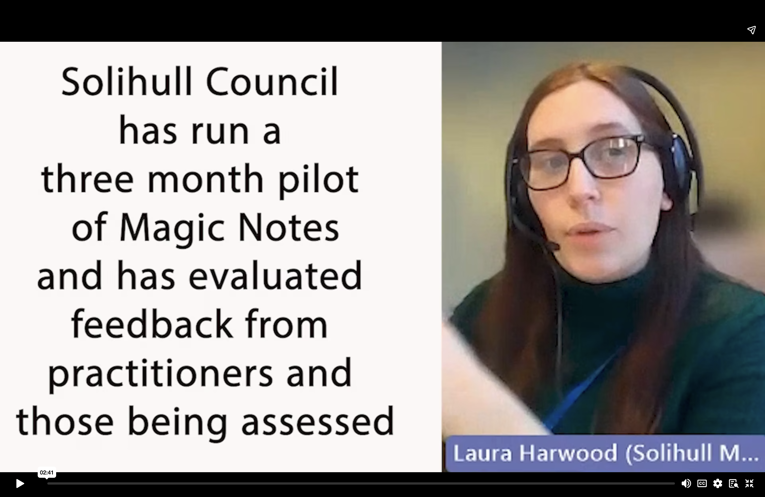
Still from the video of Solihull's presentation at the WM ADASS AI webinar February 2025
For some practitioners, including those with disabilities, these tools provide an opportunity to help them manage cognitive load caused by administrative pressure.
However, this shift also raises important questions.
AI systems are not neutral. They can mirror and perpetuate existing forms of oppression. Concerns raised through the Communities of Practice include:
- Algorithmic bias within AI systems
- Hallucinations, inaccuracies in transcription and summarisation
- Questions of accountability, transparency and professional responsibility
- The risk of over-reliance on automated outputs and the implications for professional confidence.
Research by the Ada Lovelace Institute documented that one social worker utilised a transcription tool to create a summary and it erroneously “indicated that there was suicidal ideation” although ‘at no point did the client actually, you know, talk about suicidal ideation or planning, or anything’. The social worker added: “If I hadn’t checked that and it had gone into the case note… that could have had implications further on down the road.” This incident highlights the need for vigilance and oversight when using AI tools.
This brings into focus a critical issue: how do we ensure that AI supports professional judgement rather than undermines it?
Bringing the Perspectives Together
These two perspectives, lived experience and professional practice, are interconnected.
At one end, people are using AI to live more independently.
At the other end, professionals are using AI to interpret, record, analyse assessments and produce summaries.
If these developments happen in isolation, there is a risk that AI becomes something that is done to people rather than shaped with them.
Key questions emerge:
- Do people who access adult social care understand how AI is being used in their interactions with adult social care workers?
- Do practitioners understand how people are already using AI in their everyday lives?
- How do we ensure transparency and shared understanding?
A Shared Opportunity
The WM ADASS AI Playbook offers one way of addressing this gap by grounding AI in real stories and lived experience.
Alongside this, emerging research into AI and social work practice is helping us to critically examine how these tools are being introduced and used.
Together, they point towards a shared opportunity to:
- embed ethical, human rights-based approaches to AI
- support practitioners to use AI critically and confidently
- ensure lived experience shapes design and implementation
- build trust through transparency and dialogue
Looking Ahead
AI has the potential to support independence, reduce burden, and open up new possibilities within adult social care.
But it also raises fundamental questions about power, accountability, and what it means to care.
If we are to realise the benefits of AI, we need to keep these conversations grounded in real lives and ensure that innovation is shaped through collaboration between people who draw on care and those who support them.
This blog is the beginning of that conversation. We will continue to develop this work, including further research and potential publication with organisations such as BASW, to explore how AI can be used responsibly, ethically, and in ways that genuinely support people to live the lives they want to lead.
Further Reading