
The following post captures reflections from a conversation between Pete Jackson, Improvement Director for WM ADASS, and Catherine Holden, a social worker in Wolverhampton working with WM ADASS to engage social work practitioners in research.
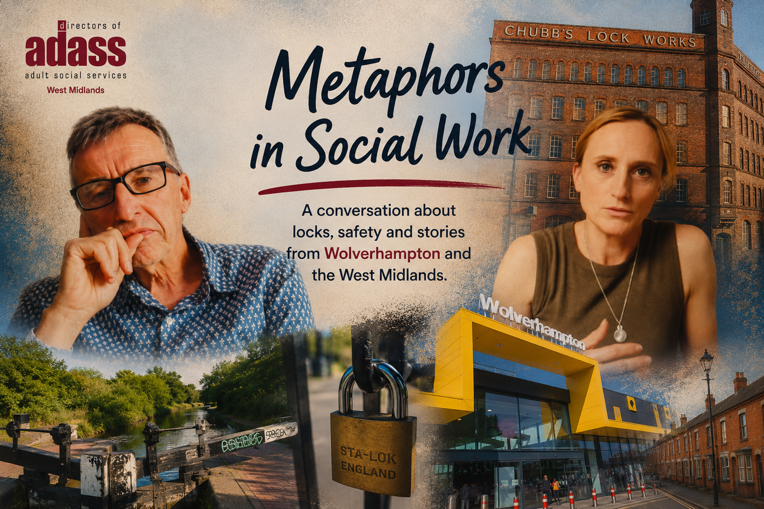
We started with a simple thought: social work and social care are full of metaphors. We talk about journeys, pathways, thresholds, safety nets, front doors and people navigating the system. These phrases are so familiar that we often stop hearing them.
Pete Jackson is Improvement Director for WM ADASS. Catherine Holden is a social worker in Wolverhampton who is working with WM ADASS to engage social work practitioners in research. Pete had been collecting metaphors he had encountered throughout his working life; Catherine brought a social work and research perspective. Together, we wondered what might happen if we slowed down and listened to the language we use.
We recorded our conversation, asked Copilot to transcribe the discussion, and then used it to help shape the ideas into this blog. That feels fitting, because the piece itself is not a polished argument so much as a conversation — one that started with curiosity and kept opening up new questions.
We were not trying to prove anything. We simply wanted to ask: what does a metaphor help us see, and what does it hide?
A strengths-based approach is a good example. It directs attention towards what somebody can do rather than what they cannot. That matters. But by illuminating strength, what might it place in the shadows: risk, difficulty, or the conditions around someone that make them unsafe?
Catherine reflected on the word vulnerable. It can sound as if vulnerability sits inside the person, rather than in the situation around them. The question changes if we ask, “What is happening around this person that is making them unsafe?”
This took us to the idea that words create worlds — a phrase associated with Rabbi Abraham Joshua Heschel. In social care, Bryony Shannon develops a similar argument: the words we use reflect our values and influence the way we think, feel and behave. Professional language can be useful shorthand, but it can also become service speak. Assessments, outcomes, care plans and interventions may help professionals organise complexity, yet they can also distance us from the human experience underneath. The language we choose doesn't simply describe people's lives; it helps shape the story we tell about them and the possibilities we imagine.
We also wondered whether metaphor could become a form of inquiry in its own right. Rather than professionals deciding which images best describe social care, what would happen if we asked people drawing on care and support: if your experience were an object, a journey, a landscape or a picture, what would it be — and why?
This was where the conversation became more grounded, and more interesting. We both work in the West Midlands, where we talk a lot about place. But place can become another piece of professional shorthand unless we ask what it actually means to people who live there. What if our metaphors grew from the places themselves — from buildings, histories, industries, landscapes, football clubs, canals and local stories? Would that help us speak about care in a way that felt less imported and more rooted?
Pete lives in Telford, a new town built among much older communities. Even that phrase, new town, carries a metaphorical charge. It says something about renewal and planning, but it also raises questions about what came before, what was displaced, and which histories remain visible.
Catherine works in Wolverhampton. Pete remembered the old Chubb building near the railway station. Chubb made locks and safes. Suddenly, the place itself offered us a metaphor: the lock and the key.
A lock protects something valuable. Social work has responsibilities around safeguarding and protection. But locks also restrict. They decide who can enter, who can leave, and who has permission.
So the metaphor quickly became practical and political. Who decides that the door should be locked? Who holds the key? Who has the power to unlock it? And does the person ever get the key back?
Those questions took us straight into autonomy, safeguarding, best-interest decisions, restriction, deprivation of liberty and human rights. They also showed why place-based metaphors matter. They are not decorative. They can open up difficult ethical conversations in ways that feel immediate and recognisable.
Catherine noticed something happening in her own thinking. Although she naturally thinks about strengths, the image of the lock took her first towards protection. Only after talking it through did another reading emerge: unlocking potential.
Same object. Different emphasis. Different story.
That felt important. Metaphors do not just describe our thinking. They reveal it, and sometimes they change it.
Other West Midlands images followed. Canals suggested connection and navigation, although Catherine asked whether canals also imply a predetermined route. Wolverhampton Wanderers prompted the wolf pack: belonging, identity and collective strength, but perhaps at the expense of individuality. Catherine suggested a lighthouse, illuminating possibilities rather than steering somebody away from the rocks, before we smiled at the obvious problem that Wolverhampton is not especially known for lighthouses. That was part of the point. A metaphor needs to carry meaning in context.
Finally, we arrived at the orchestra. The familiar image is the conductor who helps different musicians come together. Then Catherine turned it around. What if the person drawing on support is the conductor?
Perhaps there is no perfect metaphor for social work. Maybe the aim is not to find one image that explains everything, but to keep asking what each image makes visible, what it pushes into the background, and whose experience it reflects.
For us, the place-based metaphors felt especially powerful because they were not abstract. They came from real places, local histories and shared memory. They helped us ask grounded questions about care, power and belonging.
So perhaps the question for anyone reading is this: what metaphors do you use when you talk about social work and social care — and what might those metaphors help you see, hide, or unlock?