
One of the most common things I hear when speaking with colleagues across adult social care is:
"I'm not a researcher."
Sometimes it's followed by:
"I wouldn't know where to start."
Or:
"Research is something universities do, not something we do in social care."
Yet every time I hear this, I find myself thinking exactly the opposite.
Over the last few years, I've had the privilege of working alongside practitioners, commissioners, providers, people with lived experience, researchers and leaders across the West Midlands. What strikes me time and time again is that many of the skills that underpin good research are already being used every day in social care practice. We just do not always recognise them as research skills.
In fact, some of the most powerful research I have seen has not started in a university at all. It has started with a practitioner asking a question, a commissioner trying to understand a problem, or a person with lived experience challenging us to do better. It is from this curiosity that research begins.
I remember being a mum of two children under five, and hearing from my psychology lecturer that children under five could experience clinical depression. My curiosity and concern led me to join the Cardiff Child Development Study as a Research Associate and subsequently completed my PhD researching early signs of emotional disorders in children.
Today, I want to share with you three recent West Midlands social care examples that demonstrate this curiosity to research path perfectly. Each of these examples combined the curiosity of social care practitioners and people with lived experience, with university expertise on research through our strong West Midlands research collaborations.
Three Different Questions, Three Different Research Journeys
The first began with the experiences of parents seeking support for autistic children.
The second emerged from an urgent workforce challenge involving international care workers.
The third started with a question about what adult social care might need to look like in 2035.
At first glance, they seem unrelated, but all three followed a remarkably similar path.
Example 1: Autism and Parental Blame
The Autism Parental Blame study started with something practitioners and families were noticing in everyday practice: parents often reported feeling blamed rather than supported when seeking help for their children. The research explored parents' experiences alongside practitioner perspectives to understand why this happened and what could be done differently. It centred lived experience, surveyed parents and practitioners, and identified opportunities to improve practice across health, education and social care. (Insert link to report and/or photo)
The starting point was not a research method, it was a question:
Why are families experiencing this, and what can we learn from it?
Example 2: International Recruitment
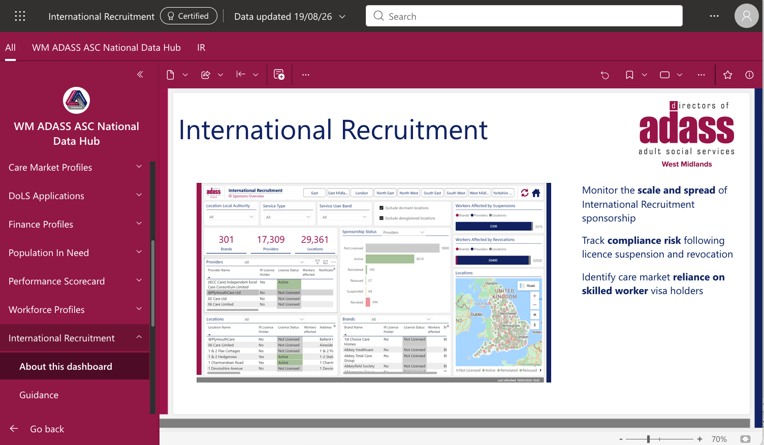
The International Recruitment Programme began with a different challenge. Councils, providers and regional partners were responding to workforce pressures, ethical recruitment concerns and the displacement of international care workers. The issue quickly became about much more than recruitment. It touched safeguarding, employment rights, workforce sustainability, market resilience and system leadership.
The programme drew together workforce intelligence, programme data, provider feedback, local authority insight and the lived experiences of international care workers. The result was a regional approach that created practical support while generating learning that can now inform wider workforce planning across adult social care.
Again, it started with a practical question:
How can we respond ethically and effectively to a complex workforce challenge?
Example 3: Future Thinking
The Future Thinking programme asked an entirely different question.
Instead of focusing on a current issue, it explored uncertainty and the future. Working with partners, the programme examined emerging trends and developed scenarios to understand what adult social care might need by 2035. It was not about predicting the future. It was about helping leaders think differently, explore possibilities and identify the capabilities needed for resilience. (insert link and/or photo)
This work ultimately produced six resilience capabilities that continue to shape regional thinking about workforce, communities, technology, evidence and leadership.
The question Directors across the West Midlands were asking was:
What do we need to start doing now to prepare for an uncertain future?
From these 3 examples we can illustrate that the difference between everyday experiences, improvement and formal research is often not the question itself, but how systematically we explore it, learn from it and share what we discover.
Today, I want to introduce a simplified, experiential model for social care practitioners to bridge the shift from practice improvement work to more formal research, based on the Theory of Change, often used in research to evaluate the societal impact of change.
Experience to Research Framework: Ask, Explore, Act, Learn, Share
Although the 3 examples described are very different, they all followed the same basic pattern that I have pulled into this simple experience to research framework:
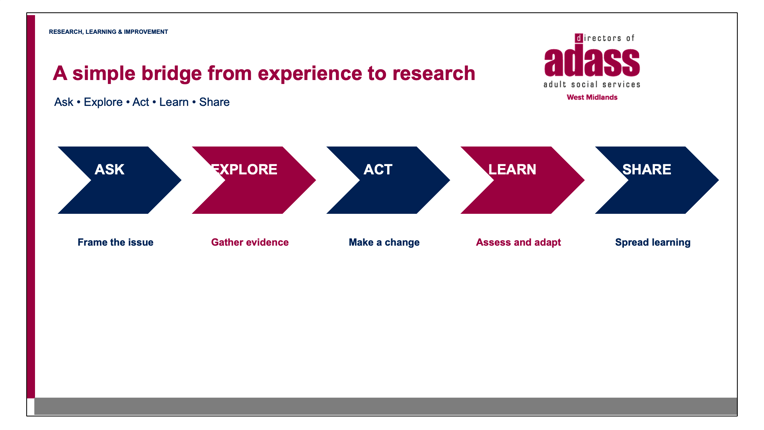
Ask
What is the problem, opportunity or question?
Why are families experiencing parental blame?
How can we better support international care workers?
What capabilities will social care need in 2035?
Every research journey starts with curiosity.
Explore
What do we already know?
The autism study combined surveys, focus groups and lived experience.
The international recruitment programme brought together workforce intelligence, evaluation data and stakeholder insight.
Future Thinking used environmental analysis, scenario development and collaborative workshops.
This stage is often already happening in practice when colleagues review data, speak to people and gather information.
Act
What are we going to do?
Research should not sit on a shelf.
The autism work identified recommendations around autism-informed practice, relational approaches and valuing parental expertise.
The international recruitment programme developed practical infrastructure, support routes and regional coordination mechanisms.
Future Thinking produced a scenario toolkit and resilience framework that practitioners and leaders could use locally.
Learn
What changed?
What worked?
What surprised us?
The most valuable learning often comes from understanding not only what happened, but why it happened. The lessons from the 3 examples extended far beyond the original questions and generated wider insight for services, systems and partners.
Share
How can others benefit?
This is the step we often overlook and is crucial as the value of learning increases when it is shared.
A conversation becomes a case study.
A local improvement project becomes a conference presentation.
A piece of regional work informs national policy.
Knowledge that remains local can only improve one service but knowledge that is shared can improve many.
So why not start recording what you already do?
One of the simplest things any of us can do is begin capturing our learning more systematically. This might include:
Questions emerging from practice
Reflections from supervision
Service review findings
Feedback from people who draw on services
Trends in local data
Learning from improvement projects
You do not need a research database.
You do not need to call yourself a researcher.
You simply need to start noticing, recording and reflecting.
A reflective note today could become a case study tomorrow.
A service review could become a conference poster.
A conversation with people who have lived experience could shape a future research project.
The Research Movement Starts With Us
Perhaps the most important message I want to leave you with is this:
We do not need to start by learning entirely new skills. We need to recognise the skills we already have. The way we listen. The way we identify patterns. The way we weigh evidence. The way we involve people with lived experience. The way we reflect and adapt our practice. These are all foundations of good social care research.
The Autism Parental Blame study, the International Recruitment Programme and the Future Thinking work all started in different places. One began with lived experience, one with a workforce challenge and one with uncertainty about the future. Yet all three demonstrate the same principle, that research does not sit separately from experience and practice.
So next time you find yourself being curious, asking a question, noticing a pattern, testing a new idea or learning from someone's experience, pause for a moment and ask:
Could this be the start of a research journey?
Get in touch if you are interested in getting involved in WM ADASS Research Programme: info@wm-adass.org.uk